
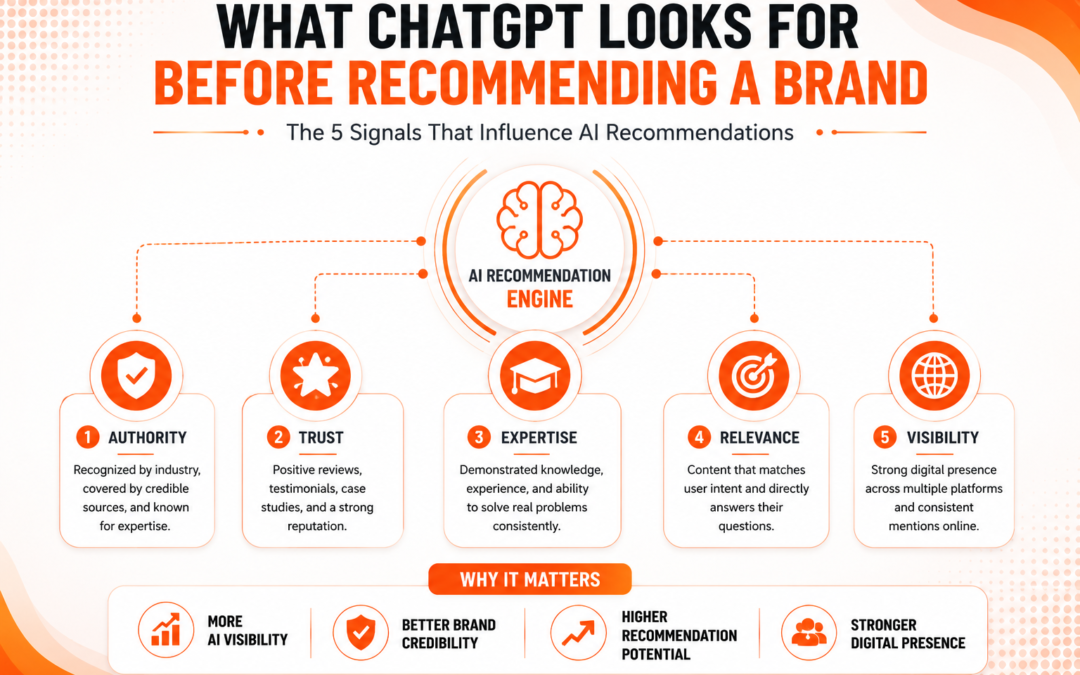
Why some businesses appear in AI-generated answers while others remain invisible
ChatGPT recommends brands based on signals such as authority, trust, expertise, relevance, and digital visibility. Businesses that consistently publish helpful content, build credibility, earn customer trust, and establish a strong online presence are more likely to appear in AI-generated answers. As AI-powered search continues to grow, brands must optimize not only for Google but also for AI recommendation systems.
Contents
- 1 The Way People Search Is Changing
- 2 ChatGPT Doesn’t Recommend Brands Randomly
- 3 Signal #1: Authority
- 4 Signal #2: Trust
- 5 Signal #3: Expertise
- 6 Signal #4: Relevance
- 7 Signal #5: Visibility Across Multiple Platforms
- 8 Why Personal Branding Matters
- 9 The Role of Content Quality
- 10 Why Consistency Matters
- 11 The Shift From SEO to AI Search Optimization
- 12 What Businesses Should Do Today
- 13 The Future of Brand Discovery
- 14 Final Thoughts
- 15 Frequently Asked Questions
- 15.1 Does ChatGPT recommend brands based on Google rankings?
- 15.2 What is the most important factor for AI visibility?
- 15.3 Can small businesses appear in AI-generated answers?
- 15.4 Why is personal branding important for AI visibility?
- 15.5 What is AI Search Optimization?
- 15.6 How can businesses prepare for the future of AI search?
The Way People Search Is Changing
For years, businesses focused on ranking on Google.
The strategy was simple.
Choose keywords.
Optimize pages.
Build backlinks.
Rank higher.
Generate traffic.
While SEO remains important, a major shift is happening.
People are increasingly asking AI platforms such as ChatGPT, Gemini, Copilot, and Perplexity questions instead of browsing through multiple websites.
Instead of searching:
“Best CRM software”
Users ask:
“What CRM software is best for a growing business?”
Instead of reading ten articles, they receive a direct answer.
This change is transforming digital marketing.
Businesses are no longer competing only for rankings.
They are competing for recommendations.
That raises an important question.
What exactly does ChatGPT look for before recommending a brand?
ChatGPT Doesn’t Recommend Brands Randomly
Many business owners assume AI recommendations are based solely on popularity.
Others believe the biggest advertising budget wins.
Neither assumption is accurate.
AI systems are designed to provide helpful and relevant answers.
To achieve that goal, they evaluate signals that indicate whether a brand is credible, trustworthy, and knowledgeable.
Think of ChatGPT as a highly informed assistant.
If someone asks for a recommendation, it tries to identify the most useful answer based on the information available.
That means businesses need to focus on becoming trustworthy sources rather than simply chasing rankings.
Signal #1: Authority
Authority is one of the strongest indicators of credibility.
Authority answers a simple question:
“Is this brand known for this topic?”
Imagine two websites.
The first publishes one article about digital marketing.
The second publishes hundreds of articles covering SEO, content marketing, AI search, social media, analytics, and lead generation.
Which website appears more authoritative?
The answer is obvious.
Authority develops when businesses consistently create valuable content around a specific subject.
How Authority Is Built
- Publishing educational articles
- Sharing case studies
- Conducting research
- Producing industry insights
- Answering common questions
Authority is not created overnight.
It grows through consistency.
The businesses that become known for a topic often become easier for AI systems to recommend.
Signal #2: Trust
Trust has always been important.
In the age of AI search, it is becoming even more valuable.
When ChatGPT recommends a brand, it is essentially helping a user make a decision.
That means trust signals matter.
Examples include:
- Positive reviews
- Customer testimonials
- Industry recognition
- Awards
- Case studies
- Transparent business information
Trust reduces risk.
The stronger the trust signals, the easier it becomes for AI systems to identify a business as credible.
Think about your own behavior.
Would you choose a business with hundreds of positive reviews or one with no reputation at all?
AI systems often follow similar logic.
Signal #3: Expertise
People want answers from experts.
AI systems know this.
Expertise refers to the depth of knowledge demonstrated by a business or individual.
Expertise is often visible through:
- Detailed content
- Educational resources
- Thought leadership
- Practical examples
- Real-world experience
Many companies create content focused entirely on selling.
The most successful brands focus on teaching.
When businesses consistently educate their audience, they demonstrate expertise.
That expertise becomes a valuable recommendation signal.
Signal #4: Relevance
Even the most authoritative brand may not appear if its content is not relevant to the user’s question.
Relevance is about matching intent.
For example:
If a user asks:
“How can I improve local SEO?”
A general article about marketing may not be enough.
A detailed guide specifically focused on local SEO is much more relevant.
AI systems evaluate:
- User intent
- Context
- Topic alignment
- Content quality
The more directly your content answers a question, the more useful it becomes.
Useful content has a greater chance of being referenced.
Signal #5: Visibility Across Multiple Platforms
Many businesses rely solely on their websites.
That approach is becoming increasingly risky.
AI systems often evaluate information from multiple sources.
This includes:
- Websites
- Medium
- YouTube
- Business directories
- Industry publications
- Online reviews
A strong digital footprint helps establish credibility.
When a brand appears consistently across multiple platforms, AI systems gain more confidence in its authority.
Visibility creates familiarity.
Familiarity builds trust.
Trust increases recommendation potential.
Why Personal Branding Matters
People trust people more than logos.
This is one of the most important lessons in modern marketing.
A founder, consultant, specialist, or industry expert often becomes the face of a brand.
When that person consistently shares insights and expertise, they strengthen the brand’s authority.
Personal branding creates:
- Trust
- Credibility
- Recognition
- Authority
This is one reason why thought leaders often appear prominently in AI-generated answers.
Their expertise is visible.
Their reputation is established.
Their authority is recognized.
Businesses that invest in personal branding often gain an additional advantage in AI search visibility.
The Role of Content Quality
Content remains the foundation of visibility.
However, quality matters more than quantity.
AI systems increasingly prioritize content that is:
- Helpful
- Clear
- Accurate
- Relevant
- Well-structured
Good content answers questions.
Great content solves problems.
Businesses should focus on creating resources that genuinely help their audience.
When content becomes useful, it naturally attracts attention.
That attention contributes to authority and trust.
Why Consistency Matters
Many businesses publish content for a few months and then stop.
Authority does not work that way.
Consistency sends important signals.
It demonstrates:
- Commitment
- Activity
- Relevance
- Expertise
One article can help.
Fifty articles can establish authority.
One social media post can create awareness.
Years of consistent publishing can build a reputation.
The brands that appear most frequently in AI-generated answers often have one thing in common.
They consistently create value.
The Shift From SEO to AI Search Optimization
Traditional SEO remains important.
People still use Google every day.
However, a new discipline is emerging.
Many marketers now refer to it as:
- AI Search Optimization
- Answer Engine Optimization (AEO)
- Generative Engine Optimization (GEO)
The objective is no longer just ranking.
The objective is becoming the answer.
This requires businesses to think differently.
Instead of asking:
“How do I rank?”
They should ask:
“How do I become the most trusted source?”
That simple shift changes everything.
What Businesses Should Do Today
If your goal is to improve visibility in AI-generated answers, focus on the fundamentals.
Create Helpful Content
Answer questions.
Solve problems.
Educate your audience.
Build Topical Authority
Become known for a specific subject.
Depth matters.
Earn Trust
Collect reviews.
Share customer stories.
Demonstrate results.
Strengthen Personal Branding
People trust experts.
Build visibility around expertise.
Expand Your Digital Presence
Be active where your audience spends time.
Stay Consistent
Authority compounds.
Trust compounds.
Visibility compounds.
The Future of Brand Discovery
The future of digital marketing is changing rapidly.
AI-powered search is becoming a major discovery channel.
Businesses that focus only on rankings may find themselves invisible.
Businesses that focus on authority, trust, expertise, and helpful content will be better positioned for success.
The goal is no longer just being found.
The goal is being recommended.
That is the difference between visibility and influence.
Final Thoughts
ChatGPT does not recommend brands because they spend the most money.
It recommends brands that demonstrate credibility.
Authority matters.
Trust matters.
Expertise matters.
Relevance matters.
Visibility matters.
Businesses that consistently provide value create stronger recommendation signals.
As AI search continues to evolve, the brands that win will be the ones that become trusted sources of information.
The future belongs to businesses that help first and sell second.
Frequently Asked Questions
Does ChatGPT recommend brands based on Google rankings?
Not exclusively. Rankings help, but AI systems also evaluate authority, trust, expertise, and relevance.
What is the most important factor for AI visibility?
There is no single factor. Authority, trust, expertise, and helpful content work together to improve visibility.
Can small businesses appear in AI-generated answers?
Yes. Smaller businesses with strong expertise and useful content can compete effectively against larger brands.
Why is personal branding important for AI visibility?
Personal branding creates authority and trust signals that can influence recommendations.
What is AI Search Optimization?
AI Search Optimization focuses on improving visibility in AI-generated answers from platforms such as ChatGPT, Gemini, Copilot, and Perplexity.
How can businesses prepare for the future of AI search?
Focus on creating helpful content, building authority, earning trust, strengthening personal branding, and maintaining a consistent digital presence.