
Contents
- 1 Meta Ads in 2026: Why Creative Is the New Targeting — An AI Digital Marketing Expert Breakdown
- 1.1 The Old Way Is Dead: What Meta Ads 2026 Changed (And Why It Stopped Working)
- 1.2 Advantage+: The Meta Ads 2026 Campaign Type That Changed Everything
- 1.3 Creative Is the New Targeting: What Meta Ads 2026 Actually Means in Practice
- 1.4 Fix Your Tracking Before You Scale Any Meta Ads 2026 Campaign
- 1.5 Simplify Your Meta Ads 2026 Account Structure
- 1.6 How to Diagnose When Your Meta Ads 2026 Performance Drops
- 1.7 The Meta Ads 2026 Mindset Shift That Changes Everything
- 1.8 Meta Ads 2026 Quick-Start Action List
Meta Ads in 2026: Why Creative Is the New Targeting — An AI Digital Marketing Expert Breakdown
If you are still running Meta Ads 2026 the way you ran campaigns back in 2022, stacking five interest layers, micro-segmenting audiences, obsessing over placements, you are burning money. The platform has fundamentally changed. The marketers who have not adapted are watching their results fall apart and wondering what went wrong.
As an AI Digital Marketing Expert, I have been running paid social campaigns for years. This shift through 2024 into 2026 is the biggest structural change I have seen in Meta advertising. The short version? The algorithm is now so powerful that your targeting barely matters anymore. Your creative is everything.
In this post, I — Manoj Natesan, AI Digital Marketing Expert — am going to break down exactly what changed, why it changed, and the specific actions you need to take right now. No fluff. Just the strategic and tactical shifts that are actually moving the needle.
The Old Way Is Dead: What Meta Ads 2026 Changed (And Why It Stopped Working)
For a long time, the winning formula on Facebook and Instagram was precision targeting. As an AI Digital Marketing Expert working with brands across industries, I watched everyone layer interest groups, combine them with Lookalike Audiences, exclude recent purchasers, and run tight campaign structures with strict budget controls per ad set.
That approach worked because Meta’s algorithm needed your help. It needed you to tell it who to show your ads to because it did not have enough data or compute power to figure it out on its own.
That is no longer the case. In Meta Ads 2026, Meta has invested billions into AI infrastructure including the Andromeda engine. Every AI Digital Marketing Expert I know has noticed the same thing: the algorithm now predicts who will convert better than any manual audience stack you build. Narrow your targeting aggressively and you are not helping it. You are constraining it.
The data backs this up. Advertisers who switched to Advantage+ campaigns saw an average of 22% higher Return on Ad Spend compared to manual campaigns, with some accounts reporting up to a 26% lower Cost Per Acquisition. The direction is clear.
Advantage+: The Meta Ads 2026 Campaign Type That Changed Everything
If you are not yet using Advantage+ campaigns, this is the first thing any AI Digital Marketing Expert will tell you to change. This is where to start.
Advantage+ is Meta’s fully automated campaign type. You provide your budget, your creative assets, and your conversion objective. The system handles targeting, bidding, and placement optimization entirely on its own. No audience boxes to tick. No placement overrides. You step back and let the machine do the targeting.
What makes Advantage+ particularly powerful is how it handles creative. The system can simultaneously test up to 150 different creative combinations, mixing different videos, images, headlines, and body copy, and dynamically serve the best-performing combinations to the most receptive audiences. No human media buyer can replicate that testing velocity manually.
But here is the important nuance: Advantage+ works best when you feed it excellent creative to begin with. This is something every AI Digital Marketing Expert agrees on. The automation amplifies what you give it. Feed it weak creative and the algorithm scales your weak creative efficiently. That is not what you want.
The practical recommendation is what I call the “test outside, scale inside” framework:
- Phase 1 (Validation): Run a controlled manual campaign with small budgets to test new creative concepts head-to-head. This ensures new ads are not competing unfairly against established ads with longer performance history.
- Phase 2 (Scaling): Once a creative demonstrates strong CTR or low CPA in your test environment, move it into your Advantage+ campaign for broader scaling.
This protects your budget during testing while still letting you take full advantage of Meta Ads 2026 automation when you scale winners.
Creative Is the New Targeting: What Meta Ads 2026 Actually Means in Practice
When people say “creative is the new targeting” in the context of Meta Ads 2026, it sounds like a catchy tagline. But as an AI Digital Marketing Expert who runs these campaigns daily, I can tell you what it actually means for how you build and test your ads.
Here is the mechanism. Meta’s algorithm reads the content of your ad, the visuals, the text, the language, the emotional tone, and uses it as a signal to find the right audience. If your ad shows a tired parent at 6am reaching for their coffee while staring at a pile of laundry, Meta’s system will find people who relate to that specific feeling. You are not targeting “parents aged 25 to 45.” You are targeting an emotional state through your creative.
That means your creative strategy needs to work harder than ever. And as an AI Digital Marketing Expert, the creative brief is now where I spend most of my strategic time.
Build Ad Families, Not Ad Variations
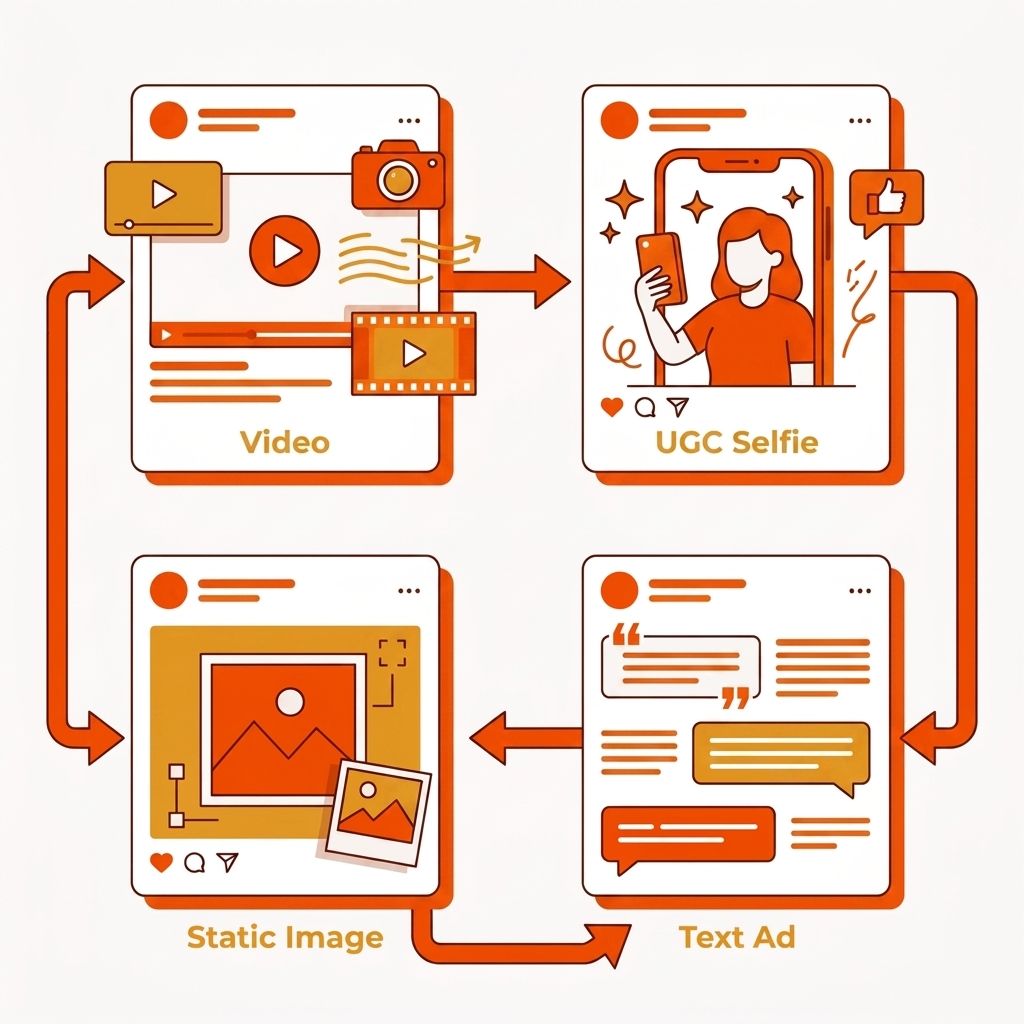
The old approach was to run the same ad with minor tweaks, a different headline, a different button colour. That no longer works. Instead, build what I call ad families: groups of ads that share the same core message but use completely different formats and angles.
For example, if your core message is “our software saves teams three hours per day,” your ad family might include:
- A UGC-style video of a real customer talking about their experience
- A day-in-the-life screen recording showing the tool in action
- A static infographic showing the before and after time comparison
- A text-heavy ad that reads like a personal story from the founder
Each format will resonate differently with different people. By building a family rather than running minor variations, you give Meta’s algorithm a richer signal set to work with. This is a core principle I teach as an AI Digital Marketing Expert to every brand I work with.
Expect Creative Fatigue Around 21 Days
Here is one of the most actionable data points for Meta Ads 2026: the average creative lifespan on Meta is approximately 21 days before performance starts to deteriorate. This does not mean your creative automatically dies at day 22. Some evergreen angles run longer. But it does mean you need a rolling creative production schedule, not an ad-hoc one.
Build this into your workflow. If you are not producing new creative assets every two to three weeks, you will eventually hit a wall where your CPMs are rising, your ROAS is falling, and you have nothing fresh ready to replace what has fatigued.
Write Copy That Acts as a Targeting Signal
Because Meta’s AI reads your copy to find the right audience, your ad text needs to be specific and intentional. As an AI Digital Marketing Expert, I always push clients to stop writing generic copy like “Get the results you deserve” and start writing lines like “If you are a freelance designer spending three hours chasing invoices every week, this is for you.” That specificity tells the algorithm exactly who to find.
Think of your headline and first line of body copy as the primary audience signal. The more precisely you describe a specific person’s problem or situation, the more precisely the algorithm can match your ad to the right people.
Fix Your Tracking Before You Scale Any Meta Ads 2026 Campaign
Here is the conversation that every AI Digital Marketing Expert dreads having after results fall apart: if your tracking infrastructure is broken, no Meta Ads 2026 strategy will save you. You cannot optimise what you cannot measure, and browser-side tracking alone is not reliable enough to run serious campaigns today.
The problem is privacy. Safari and Firefox both limit or block third-party cookies. iOS 14 and beyond introduced App Tracking Transparency, which lets users opt out of cross-app tracking entirely. Ad blockers intercept and kill the Meta Pixel for a real percentage of your visitors. If you are only running the Meta Pixel, you are likely missing 30 to 50% of your actual conversion data. Your algorithm is learning on incomplete information.
The solution is the Conversions API, or CAPI. It is a server-side tracking method that sends event data directly from your server to Meta’s servers, bypassing the browser entirely. Because it runs server to server, it is invisible to ad blockers and not affected by browser privacy settings.
The best practice is a hybrid setup: run both the Meta Pixel and CAPI at the same time, with event deduplication enabled using unique Event IDs. The Pixel captures browser-side signals. CAPI fills in the gaps. Together, they give your algorithm the complete picture it needs to optimise properly.
If you are on Shopify, the native Meta integration now handles CAPI automatically. If you are on a custom stack, you will need to implement CAPI through Meta’s API directly or use a server-side tag management solution.
Do not skip this. As an AI Digital Marketing Expert, tracking setup is the first thing I audit before touching a single campaign. Every rupee you spend on creative and media is worth less when your algorithm is optimising on half the data.
Simplify Your Meta Ads 2026 Account Structure
One of the most counterintuitive things about Meta Ads 2026 is that less account structure performs better than more structure. In the old paradigm, you would run 10 to 15 ad sets, each targeting a different audience segment, so you could see which one performed best. Today, that fragmentation hurts performance.
Here is why. Each ad set needs to go through a learning phase before it can optimise effectively. An AI Digital Marketing Expert managing multiple accounts sees this constantly: the more ad sets you run on smaller budgets, the longer it takes each one to exit the learning phase. You often pull budgets before any ad set has generated enough data to learn properly.
When you consolidate into fewer campaigns with larger budgets, you give the algorithm more data faster. It learns more efficiently, exits the learning phase sooner, and delivers better results in less time.
If you currently have 8 ad sets targeting slight variations of the same audience, try consolidating them into 2 or 3 broader ad sets with combined budgets. Use Advantage+ Audience and let the algorithm find the right people within that broader pool.
How to Diagnose When Your Meta Ads 2026 Performance Drops
One of the most valuable frameworks I use as an AI Digital Marketing Expert when a Meta Ads 2026 campaign performance drops is a simple three-metric audit. Instead of panic-adjusting everything at once, I check these three metrics in order:
- CTR (Click-Through Rate): If this is declining, the problem is your creative or your angle. The ad is not stopping the scroll or compelling people to click. The fix is fresh creative.
- CVR (Conversion Rate): If CTR is healthy but conversions are down, the problem is post-click. Your landing page, offer, or pricing is not converting the traffic you are sending. The fix is on your website, not inside Ads Manager.
- CPM (Cost Per Thousand Impressions): If CPMs are rising, it typically means your creative has lost relevance with the audience Meta is reaching, or competition in your market has increased. Rising CPMs alongside declining CTR together signal severe creative fatigue.
This sequential diagnostic process stops you from making changes in the wrong place. I have seen too many Meta Ads 2026 accounts where marketers refresh their landing pages when the CTR was the actual problem, or launch new creative when the issue was really about pricing or the offer itself.
The Meta Ads 2026 Mindset Shift That Changes Everything
The underlying theme across everything I have shared here, and what I see consistently in my work as an AI Digital Marketing Expert, is a fundamental shift in how Meta advertising works. You are no longer a media buyer who tells the algorithm where to deliver your ads. You are a creative director who gives the algorithm the best possible raw material and trusts it to find the right audience.
That shift is uncomfortable for a lot of marketers, including experienced ones, because it feels like giving up control. But the data is clear. The accounts winning right now are the ones that have fully embraced this model. They are spending more time on deep customer research, building diverse creative families, maintaining a rolling production schedule, and investing in solid tracking infrastructure.
The accounts that are struggling are still trying to outsmart the algorithm through audience manipulation, running the same creative for months, and relying on a pixel alone to report results.
Meta Ads in 2026 is not harder. It is just different. Once you align your strategy with how the platform actually works today, the results follow.
Meta Ads 2026 Quick-Start Action List
- Audit your tracking: Verify that CAPI is implemented alongside your Meta Pixel with event deduplication enabled.
- Consolidate your campaigns: If you have more than 5 ad sets in a campaign, merge them into 2 to 3 broader ad sets.
- Switch to Advantage+: Test one Advantage+ campaign alongside your existing manual campaigns and compare ROAS over 30 days.
- Build your first ad family: Take your best-performing offer and create 4 completely different creative executions of it.
- Set a creative refresh calendar: Schedule new creative production every 2 to 3 weeks to stay ahead of fatigue.
- Diagnose correctly: When results dip, check CTR, then CVR, then CPM in that order before changing anything.
Meta Ads 2026 has changed the game. The marketers who adapt will keep growing. The ones who do not will keep spending more for less.
If you want help implementing any of this for your business, whether it is a full campaign audit, creative strategy, or tracking setup, feel free to reach out. As an AI Digital Marketing Expert, this is exactly the kind of work I love helping brands get right. Working with an AI Digital Marketing Expert means your campaigns are built on data, not guesswork.