
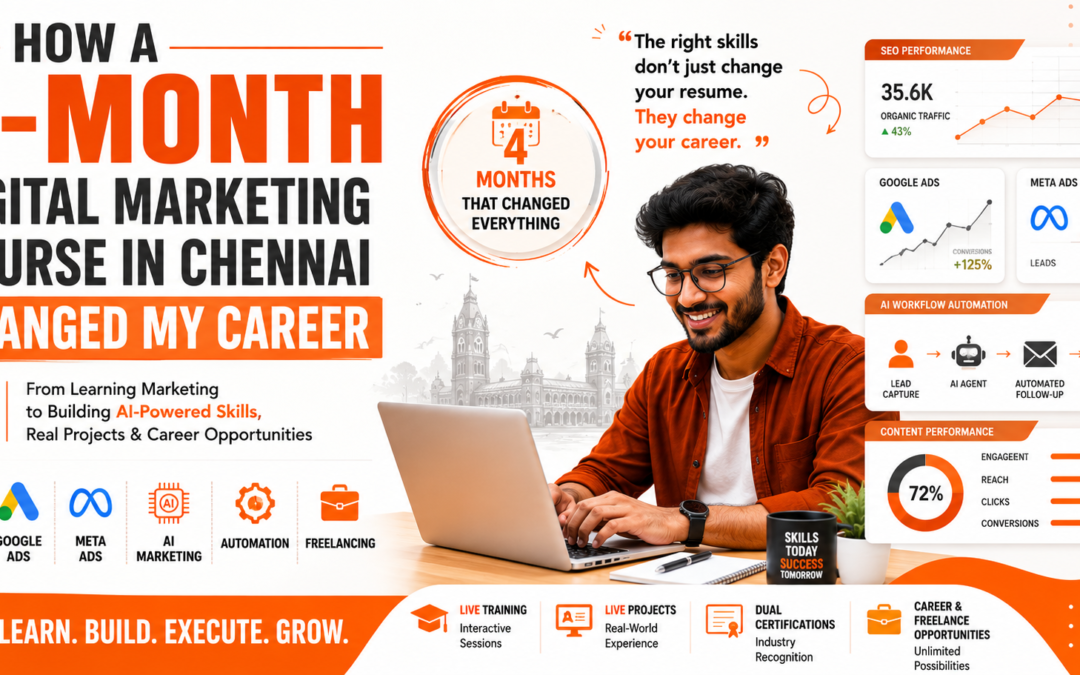
Find how a 4-month digital marketing course in Chennai transformed my career with AI-powered skills, live projects, certifications, and real-world training.
Contents
- 1 Introduction
- 2 Why I Decided to Learn Digital Marketing
- 3 My Expectations Before Joining
- 4 The First Thing That Stood Out
- 5 Understanding the New Era of Marketing
- 6 Learning Digital Marketing Through Real Skills
- 7 Google Ads Training
- 8 Meta Ads and Performance Marketing
- 9 The AI Advantage
- 10 Building AI Agents and Automation Workflows
- 11 Social Media Marketing Beyond Posting Content
- 12 The Projects That Made the Difference
- 13 Portfolio Building Changed Everything
- 14 Learning About Freelancing
- 15 Understanding Career Opportunities
- 16 What Changed for Me Personally
- 17 Why Digital Scholar Stood Out
- 18 Conclusion
- 19 FAQs
- 19.1 1. Is a 4-month digital marketing course in Chennai enough to start a career?
- 19.2 2. What skills can I learn in a digital marketing course in Chennai?
- 19.3 3. Does a digital marketing course in Chennai include AI training?
- 19.4 4. Can beginners join a digital marketing course in Chennai?
- 19.5 5. Is SEO covered in a digital marketing course in Chennai?
- 19.6 6. Will I work on projects during a digital marketing course in Chennai?
- 19.7 7. Can a digital marketing course in Chennai help with freelancing?
- 19.8 8. What job roles can I pursue after a digital marketing course in Chennai?
- 19.9 9. Why is AI important in a digital marketing course in Chennai?
- 19.10 10. Why choose Digital Scholar for a digital marketing course in Chennai?
Introduction
This article is written by Manoj Natesan, an AI Digital Marketing Expert in Chennai, sharing practical insights on SEO, AI marketing, personal branding, and growth.
When I first started searching for a digital marketing course in Chennai, I wasn’t looking for just another certification.
I was looking for a career shift.
Like many others, I spent weeks comparing institutes, reading reviews, checking course modules, and trying to understand which program could actually help me build practical skills instead of simply adding another certificate to my resume.
What I discovered was that not all digital marketing courses are built the same.
Some focus heavily on theory. Some teach outdated methods. Others barely scratch the surface of what modern marketers need to know.
My experience was different.
Completing a 4-month digital marketing course in Chennai didn’t just help me learn marketing. It completely changed the way I looked at careers, technology, AI, freelancing, and growth opportunities.
Here’s what happened.
Why I Decided to Learn Digital Marketing
The marketing industry is evolving faster than ever. Businesses are investing heavily in digital channels, AI tools are transforming workflows, and companies are actively looking for marketers who understand both strategy and technology. I wanted a skill that could:
- Open multiple career opportunities
- Help me stay relevant in a changing market
- Give me practical, job-ready experience
- Create freelancing possibilities
- Build long-term career flexibility
Digital marketing seemed to offer all of that. But I quickly realized that choosing the right course would make all the difference.
My Expectations Before Joining
Before joining the course, I assumed digital marketing was mostly about:
- Posting on social media
- Running advertisements
- Learning SEO basics
I expected to learn a few tools and perhaps earn a certification. What I didn’t expect was the level of practical exposure and AI integration that would become a major part of the learning journey.
The First Thing That Stood Out
From the beginning, the training felt different. The structure included:
- Weekly live sessions
- Weekly assignments
- Portfolio-building activities
- Capstone projects
- Live brand exposure
- Final evaluation
- Dual certification
Instead of passively consuming information, students were encouraged to build, execute, and apply what they learned. That practical approach immediately made the experience more engaging.
Understanding the New Era of Marketing
One of the biggest lessons I learned was how dramatically marketing has changed. Today’s marketers are expected to do much more than run campaigns. With AI becoming part of everyday workflows, marketers can now:
- Generate content
- Create ad copy
- Produce visuals
- Analyze data
- Plan campaigns
- Automate repetitive tasks
The course introduced this concept early and showed how AI can help marketers become more productive while still focusing on strategy and creativity. That perspective completely changed how I viewed the future of marketing.
Learning Digital Marketing Through Real Skills
The curriculum covered multiple areas that are essential in today’s marketing landscape.
Search Engine Optimization (SEO)
The SEO training started from the fundamentals and gradually moved into more advanced topics. Key areas included:
- WordPress setup
- Domain and hosting configuration
- Website optimization
- On-page SEO
- Off-page SEO
- Link building
- Local SEO
- Community SEO
- Video SEO
What I appreciated most was the emphasis on implementation rather than memorization. Every concept connected back to practical application.
Google Ads Training
Google Ads was another major learning area. The modules covered:
- Keyword research
- Search campaigns
- Display campaigns
- YouTube Ads
- Shopping campaigns
- Demand Generation campaigns
- Performance Max campaigns
- Conversion tracking
- Reporting and optimization
The structured progression made it easier to understand how advertising systems work and how campaigns are built for measurable outcomes.
Meta Ads and Performance Marketing
Before the course, Meta Ads felt complicated. By the end of the training, I understood:
- Campaign structures
- Audience targeting
- Retargeting systems
- Lead generation campaigns
- Creative testing
- Scaling strategies
- Reporting metrics
Learning how to build campaigns from the ground up gave me confidence that I never had before.
The AI Advantage
One of the most valuable parts of the course was its focus on AI. Rather than treating AI as a trend, it was presented as a practical tool that marketers need to understand. The learning covered:
Introduction to AI
Understanding:
- Large Language Models
- AI applications in marketing
- AI-driven workflows
Prompt Engineering
Learning how to communicate effectively with AI tools became a skill in itself. The framework-based approach helped produce better outputs and more efficient workflows.
Generative AI Tools
The training introduced various categories of AI tools including:
- Text generation
- Image generation
- Video generation
- Voice generation
This significantly expanded my understanding of modern marketing execution.
Building AI Agents and Automation Workflows
This was one of the most unique aspects of the program. The course introduced:
- AI agents
- Workflow automation
- Lead automation
- Chatbot systems
- Automated publishing workflows
- Content distribution systems
Using automation tools, students learned how repetitive marketing tasks can be streamlined while maintaining efficiency. It felt like learning skills that belong to the future rather than the past.
Social Media Marketing Beyond Posting Content
Many people think social media marketing is simply creating posts. The course showed how much deeper it goes. Topics included:
Instagram Marketing
Learning how to:
- Create content systems
- Generate reel scripts
- Build authority
- Plan content calendars
LinkedIn Marketing
Understanding:
- Profile optimization
- Personal branding
- AI-assisted outreach
- Content publishing
YouTube Marketing
The training covered:
- Video scripting
- SEO optimization
- Audience engagement
- Content strategy
These modules helped connect content creation with business growth objectives.
The Projects That Made the Difference
Theory is useful. Execution changes careers. Throughout the course, practical projects became a major part of the learning experience. Students worked on:
- Campaign creation
- Funnel development
- SEO implementation
- Ad strategies
- Marketing automation workflows
- Reporting systems
Every project added something valuable to my portfolio. By the end, I had work that demonstrated skills rather than simply claiming them.
Portfolio Building Changed Everything
One of the most underrated benefits was portfolio creation. Instead of completing a course and wondering what to show employers or clients, I had practical work that reflected my learning journey. That included:
- Campaign structures
- Marketing strategies
- Automation workflows
- Creative assets
- Performance reports
The confidence that comes from having real work samples cannot be overstated.
Learning About Freelancing
Another area that impacted my career trajectory was freelancing education. Many people learn marketing but struggle to monetize their skills. The course included training on:
- Niche selection
- Offer creation
- Pricing services
- Client proposals
- Outreach systems
- Discovery calls
- Client onboarding
This helped bridge the gap between learning marketing and actually earning from it.
Understanding Career Opportunities
Before joining, I thought digital marketing offered a limited set of job roles. The course revealed a much broader landscape. Potential opportunities include:
- Digital Marketing Executive
- SEO Specialist
- Performance Marketer
- Content Marketer
- Social Media Strategist
- Freelance Consultant
The exposure helped me see multiple career pathways rather than a single destination.
What Changed for Me Personally
Looking back, several things transformed my perspective.
I Became More Future-Focused
Learning AI, automation, and digital strategy showed where marketing is heading.
I Gained Practical Confidence
Projects and assignments helped me move from theory to execution.
I Learned to Think Strategically
Marketing stopped feeling like a collection of tools and started feeling like a complete business growth system.
I Built Career Flexibility
The skills apply across industries, businesses, and professional roles.
Why Digital Scholar Stood Out
After completing the program, it’s easy to understand why Digital Scholar has built a strong reputation among aspiring marketers. Several factors stand out:
- Agency-style learning
- AI-powered curriculum
- Weekly live sessions
- Portfolio development
- Live brand exposure
- Capstone projects
- Dual certification
- Placement assistance
- Freelancing support
The learning experience focuses on building practical capabilities that align with modern industry requirements.
Conclusion
A 4-month digital marketing course in Chennai did much more than teach me marketing concepts. It reshaped how I think about careers, technology, and opportunities. I learned how modern marketing works. Gained hands-on experience through projects.
I explored AI-powered marketing systems. Developed skills that apply to jobs, freelancing, and business growth. Most importantly, I left with the confidence that comes from practical experience.
If you’re looking for a digital marketing course in Chennai that combines real-world learning, AI-driven skills, project-based training, and career-focused development, Digital Scholar is a strong option to consider.
FAQs
1. Is a 4-month digital marketing course in Chennai enough to start a career?
Yes. A structured 4-month digital marketing course in Chennai can help you build practical skills, complete projects, and prepare for entry-level opportunities.
2. What skills can I learn in a digital marketing course in Chennai?
You can learn SEO, Google Ads, Meta Ads, social media marketing, AI tools, automation workflows, content marketing, and analytics.
3. Does a digital marketing course in Chennai include AI training?
Yes. Modern programs increasingly include AI tools, prompt engineering, automation workflows, and AI-assisted marketing strategies.
4. Can beginners join a digital marketing course in Chennai?
Absolutely. Most courses start with foundational concepts and gradually move into advanced topics.
5. Is SEO covered in a digital marketing course in Chennai?
Yes. SEO typically includes website optimization, keyword research, on-page SEO, off-page SEO, local SEO, and video SEO.
6. Will I work on projects during a digital marketing course in Chennai?
Yes. Practical assignments, capstone projects, and portfolio-building activities are often included.
7. Can a digital marketing course in Chennai help with freelancing?
Yes. Many programs include proposal creation, pricing, outreach strategies, and client management fundamentals.
8. What job roles can I pursue after a digital marketing course in Chennai?
Roles include Digital Marketing Executive, SEO Specialist, Content Marketer, Performance Marketer, and Social Media Strategist.
9. Why is AI important in a digital marketing course in Chennai?
AI helps marketers improve productivity, automate repetitive tasks, create content, analyze data, and optimize campaigns.
10. Why choose Digital Scholar for a digital marketing course in Chennai?
Digital Scholar offers AI-focused learning, agency-style training, practical projects, portfolio building, certifications, and career-oriented support.